
Nowadays, thoroughbred horse racing is the preferred entertainment for many punters and spectators around the world. There are plenty of events and different types of competitions, like harness, flat, and jump match races. However, thoroughbred horses are always in the spotlight! This hot-blooded breed has earned a reputation as the best on the track!
Thoroughbreds date back to the XVII – XVIII century when the first Oriental stallions were imported into England. They were three, actually, and all true representatives of this breed today can trace their pedigrees back to one of them. These stallions were imported to crossbred with the native mares and give the start of a better breed.
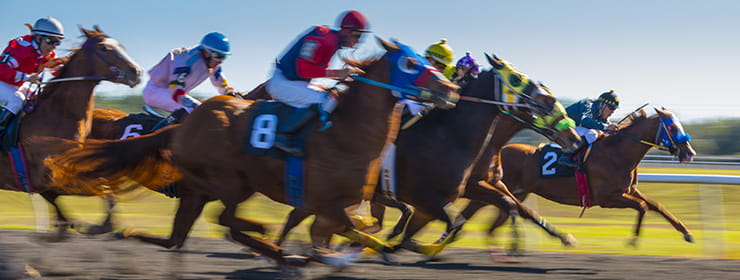
The thoroughbred horses stand out for their agility, speed, boldness, and spirit. The highest quality specimens can be easily recognised by their well-chiselled heads on long necks, deep chests and short backs, high withers and good depth of hindquarters, and long, strong legs. In the XVIII-XIX century, the thoroughbred breed spread across the world.
What is a Thoroughbred Horse?
Thoroughbred is a special horse breed used mainly for races due to proven speed, strength, agility, and spirit. Thoroughbreds are “hot-blooded” equines larger than usual horses but not too weighty. The breed was developed in England in the late 17th and early 18th centuries and later was imported first to North America.
Why Are Horses Called Thoroughbred?
The breed was developed by crossbreeding the English mares with Arabian, Barb, and Turkoman stallions. Nowadays, each thoroughbred racehorse’s pedigree leads to one of the following sires – Byerley Turk, Darley Arabian, and Godolphin Arabian. Thoroughbreds are tall and slim, and very athletic horses, which explains their use in various sports events.
Types of Thoroughbred Horse Racing
The various tracks and downs host different derbies and competitions, but the main types of thoroughbred horse racing are flat and jump! Although their names explain very well what the difference is, there are a few other aspects of the flat and jump races. The average distance is one of them!
The flat thoroughbred horse races are held on shorter distances compared to hurdle chases. The range is almost always within the range of 5 Furlongs to 2 Miles 6 Furlongs (1,000 – 4,400 metres). The jump races with Hurdles or Steeplechase fences usually start from 2 Miles up to 4 Miles 2 Furlongs.
The biggest horse racing events, like Kentucky Derby, are flat races as they are more attractive to spectators. Everything there is about speed, and because of that, the horses are younger, and the jockeys are lighter. The total weight carried by the horse can not exceed 10 Stones or 63 kg, including the saddle!
Flat Racing
Flat thoroughbred racing was formerly known as a Summer sport before 2001 when the all-weather surfaces (artificial) were introduced. That extended the season, making the discipline all year round. Before 2001, flat racing was held on grass or turf only. Only a few events are held at a shorter distance than 2 Miles (3,200 metres)!
Another important rule about flat thoroughbred horse racing is the minimum age of the steeds. As we already mentioned, they are younger compared to jump races and can compete from the age of 2. That brings more speed and aggression into major races, which is the reason why most spectators prefer those.
Some of the best horse racing events without obstacles in the UK are The Derby, The Leger, and The Oaks. We’ll explain more about them later and will say a few words about the finest festivals – Glorious Goodwood, Royal Ascot, and more. When we talk about horse major races, we must mention the money factor.
Prizes in both types of events are identical, although the earning potential in flat races is higher because of the breeding potential. A young male winner’s prize can easily exceed £40 as a perspective future stallion. Flat horses can switch to jump racing, but most come off the track at age 6 or 7.
National Hunt Racing (Jump Racing)
The National Hunt called racing in the UK, Republic of Ireland, and France, is a competition where horses need to jump over fences, ditches, and water jumps. In the United Kingdom, there are two different disciplines depending on the obstacle – hurdle or steeplechase. Bumpers are also part of the National Hunt, but they are flat races.
Hurdles are the lower-level obstacle, and horses begin racing on such tracks. The surface is usually turf or artificial, although the last is not preferred nowadays. The best horses move quickly to steeplechase fences and ditches, most often held on grass tracks. The total length is rarely lower than 3 Miles (3,600 metres).
For the jump thoroughbred horse racing, geldings are used, which have no breeding potential. Their temperament needs to be calmed down as the type of race is much more complicated. In these events, speed doesn’t matter, really, but the physical and mental ability of the horse to perform the jump without touching a rail.
Courage and gracefulness, together with physical strength, are other qualities of good thoroughbred jumping horses. Many of the finest are still competing at the age of 12! Some big horse racing events to pay attention to are during the Cheltenham and Aintree festivals, including The Grand National in April.
Major Horse Racing Events
In this section we look at some of the most famous horse racing events of the year.
Epsom Derby
Fans of thoroughbred racing will find plenty of events all year round. We already have mentioned a few, but you must really not miss even one of our picks. So, let’s begin with The Derby, taking place at Epsom Downs. It’s one of the oldest horse racing events in the United Kingdom, inaugurated in 1780.
The Derby is a relatively short-distance turf race – 1 Mile and 4 Furlongs. However, it has one of the largest purses, exceeding £1.6 million in 2022, with over £900,000 for the winner. For example, The Oaks, which is also taking place at Epsom Downs, offers 3 times less total reward!
2000 & 1000 Guineas
The 2000 Guineas Stakes and 1000 Guineas Stakes are two other popular horse racing events in the UK. They are run on the Newmarket’s Rowley Mile in late April or sometime in early May. The first race is open for both colts and fillies, while The 1000 Guineas is restricted to fillies, like The Oaks.
St Leger
Last but not least among the 5 British horse racing major events is The Leger or St Leger Stakes. It has been running on Doncaster Racecourse since 1776, and it’s open for both colts and fillies. The distance is 1 Mile and 6 Furlongs, and in 2021, the winner’s prize was nearly £500,000.
Eclipse Stakes
The Eclipse is another British horse race dating back to the XIX century (1886). It has always been run on the Sandown Park in Esher, an establishment founded by the notorious General Owen Williams. The race is named after a celebrated racehorse from the XVIII century. Nowadays, it can be run by three-year-olds and up.
Ascot Gold Cup
We already mentioned the Royal Ascot festival, so it’s time for The Ascot Gold Cup. Inaugurated in 1807, it’s scheduled to take place every June at Ascot Racecourse. The exact distance is 2 Miles 3 Furlongs, and 210 Yards. The turf track is right-handed, and the prize pool was exactly £500,000 in 2022.
Futurity Stakes
If you are looking to spectate famous racing horses in Great Britain, you must visit the Futurity Stakes. The former Racing Trophy takes place at Doncaster racecourse every October, often on soft ground. It runs over a mile and ends the Group 1 flat horse racing season in the UK.
Haydock Park Sprint Cup & The Lockinge
Before checking on some of the finest events outside the United Kingdom, we must also mention Haydock Park Sprint Cup and The Lockinge. They are run on Haydock Park Racecourse in Merseyside and Newbury racecourse, respectively. They are relatively short-distance, but you can find the best three-year-olds and four-year-old sprinters.
Prix de l’Arc de Triomphe
The Prix de l’Arc de Triomphe, or The Arc, is one of the most worthwhile international horse races. If you are in France during October’s first week, you must visit the Longchamp Racecourse in Paris. The distance is 1 Mile 3 Furlongs, and 204 Yards, and the 2021 purse was a staggering €5,000,000!
Irish Groups
To continue the flat horse racing topic, we must mention the popular Irish events. Group 1 is the peak in the racing calendar! The highest-level racehorses are running off-level weights in most cases. The best trainers and top-rated jockeys compete all year round. Group 1 races take place at Curragh and Leopardstown racecourses.
The most visited events in Group 1 are the Irish 2000 Guineas, Tattersalls Gold Cup, Irish Derby, and Flying Five Stakes. The longest distance is 1 Mile and 6 Furlongs, while the shortest is just 5 Furlongs. The Irish Group 2 and 3 also offer some thrilling sprints on the same tracks and several more.
The horses there are one or two tiers beneath the top-quality but still have plenty to offer. In these divisions, the calendar is longer, and fans can visit many more runs. Besides the tracks at Curragh and Leopardstown, Group 3 offers sprints in Dundalk, Tipperary, Cork, Naas, Navan, Fairyhouse, and Gowran Park.
The Irish Listed Horse Races are another level down! The season opens with the one-mile long Patton Stakes in Dundalk and Devoy Stakes in Naas in March. Younger horses receive a weight allowance for competing with older ones or for any previous wins, which is an identical rule to the Irish Premier Handicap races.
Breeders’ Cup
Going off Europe, we must mention the two massive horse racing tournaments in the United States. Let’s start with the Breeders’ Cup, which has been taking place every year since 1984 and in different locations. The only one outside the US was in 1996 at Woodbine Racetrack in Canada.
Races are always flat and on turf or dirt surfaces, but the distance and prize pool vary for each individual race. The biggest success was scored between 2008 and 2014 when the races were held either in Louisville, KY (Churchill Downs) or in Arcadia, CA (Santa Anita Park). The 2022 race is scheduled at Keeneland!
Kentucky Derby
Another one of the major horse racing events USA is the Kentucky Derby, which is the Triple Crown’s first leg. The race is known as the most exciting and the fastest “Two Minutes in Sports”. Kentucky Derby is a flat sprint over a one and one-quarter mile distance for three-year-old colts and fillies.
The first race was in 1875, and since then, it has been held every year at Churchill Downs, Louisville, KY. In 2019, the purse increased up to $3 million, and the winner always takes more than half. The other two legs from the Triple Crown are the Preakness Stakes and Belmont Stakes.
Pegasus World Cup
The Pegasus World Cup Invitational Stakes is a rather new event inaugurated in 2017 and held ever since then at the Gulfstream Park in Hallandale Beach, FL. It’s a thoroughbred flat sprint over 9 Furlongs on dirt for four-year-old colts and fillies. The first race in 2017 had a purse of $12 million!
Going back to the UK and, more particularly, to Liverpool, we will now announce The Grand National. It’s a jump race first run in 1839, and presently, it’s taking place at Aintree Racecourse. It’s a long handicap steeplechase covering a total distance of 4 Miles and 2.5 Furlongs. The qualifiers are seven-year-olds and up.
Dubai World Cup
Finally, we would like to highlight the Dubai World Cup, the richest thoroughbred horse race event in the world. It was competing with the Pegasus World Cup Invitational Stakes but regained its place. The run takes place at the luxury Meydan Racecourse in Dubai, UAE. The qualifying breeds are Northern Hemisphere and Southern Hemisphere.
Who Is British Thoroughbred Racing Governed By?
Thoroughbred horse races in the United Kingdom are regulated by the British Horseracing Authority (BHA). The authority has to ensure the highest standards in sport on the racecourse and away. It’s also called upon to provide “the most attractive and compelling” horse racing in the world by promoting the sport and its participants.
BHA was established in 2007 with headquarters in London. It’s the new sport governing body after the Horseracing Regulatory Authority and British Horseracing Board merger. BHA is part of the International Federation of Horseracing Authorities, which operates worldwide to regulate and assist all of its members and third parties involved.
Besides planning the different types of thoroughbred horse race events in the UK, BHA has many other essential objectives to follow. It observes and enforces disciplinary procedures to protect the sport’s integrity. It’s also responsible for licensing and registering the different racing participants and for implementing common standards for all British racecourses.
Like any other sport, thoroughbred racing could be dangerous, so rules, orders, and medical care are crucial responsibilities. They are also controlled by BHA, together with everything related to the fixture list. In conclusion, we can say that BHA is what keeps British horse racing on track!
Famous Thoroughbred Horses
There are several horses that have cemented their place in horse racing folklore. History will remember only the best, like the undefeated racehorse Kincsem, with the longest win streak of 54. It originated in Hungary and was foaled in 1984. In this section, we cover some the most famous UK and US racehorses. We’ve also got a dedicated famous thoroughbred horses page where you can find out more about each horse.
UK Famous Horses
Red Rum
Red Rum was a steeplechaser champion born on the 3rd of May 1965. It left a huge mark in thoroughbred racing by winning a treble from the Grand National. Red Rum won the races in 1973, 1974, and 1977. It also finished second in 1975 and 1976. This Irish gelding took part in exactly 100 races!
It didn’t fall even once and won 24 of them, finishing second 15 times and third 23 times. Red Rum’s sire was Quorum, and dam, Mared. The grandsire was Vilmorin, and the damsire, Magic Red. Red Rum was bred by Martyn McEnery in Kells, Ireland, at Rossenarra stud.
Red Rum won its unmatchable treble on the longest runs of 4 Miles and 4 Furlongs, despite being bred to compete in one-mile events. In 1973, it beat Crisp, an Australian chaser with a new record time just above 9 minutes. A year later, it registered a double and won the Scottish Grand National.
Despite the second place in the next couple of years, Red Rum won its Grand National treble in 1977, at the age of 12. In 1978, it retired after a hairline fracture. The news was in the media and made Red Rum a national celebrity. It died on the 18th of October 1995.
Arkle
Arkle was another thoroughbred racehorse bred in Ireland. It was born on the 19th of April 1957 on Mary Baker’s family farm in Malahow, County Dublin. The bay colt had no white markings and was a great example of a thoroughbred horse. Its sire and dam were Archive and Bright Cherry, and grandsire and damsire – Nearco and Knight of the Garter.
Nearco was unbeaten in 14 races, and Bright Cherry won over jumps 7 times. Archive, however, doesn’t have race wins in its bio! Arkle ran 35 races after it was gelded at the age of 1. It won 27, finished second twice and third 3 times. Arkle holds the highest steeplechaser TimeForm rating of 212!
Arkle has 2 trebles in its career after it won the Cheltenham Gold Cup and the Leopardstown Chase in 1964, 1965, and 1966. Among the other top wins are also the trophies from King George VI Chase in 1965, the Hennessy Gold Cup in 1964 and 1965, and the SGB Handicap Chase in 1966.
The last was held in Ascot and turned out to be the last race finished by Arkle. On the 27th of December, it took part in King George VI Chase and was injured when jumping over an open ditch. The fractured pedal bone actually put an end to its career. Arkle was put down in 1970.
Best Mate
Best Mate was an Irish-bred gelding that has won 3 times one of the most famous horse races in the UK – Cheltenham Gold Cup. It was born on the 28th of January 1995 and had a short career, collapsing and dying during the William Hill Haldon Gold Cup’s run on the Exeter Racecourse in 2005.
Best Mate’s sire was Un Desperado, the French stallion, the winner of the 1986 Prix Eugene Adam. Its dam was Katday, the grandsire was Top Ville – another French stallion, which had 6 race wins, and the damsire – Miller’s Mate. The owner of the horse was Jim Lewis, although he sold a 40% share to Markus Jooste.
The price of the share was £242,000, which isn’t bad for 2000! Best Mate is one of the UK’s most beloved racehorses and has a bronze statue near Lockinge’s farm, where it was trained in its early years. Best Mate participated in a total of 22 jumps and never fell at a fence.
Its record is 14 wins and 7 second places, including matching Arkle’s record of three Cheltenham Gold Cups, taking victories from 2002 to 2004. It was a favourite for the 2005 race but was withdrawn for health issues. Other major wins are King George VI Chase in 2002 and the Ericsson Chase in 2003.
Kauto Star
Kauto Star was a French-bred thoroughbred horse race champion from the National Hunt, with an all-time TimeForm rating of 191. It was born on the 19th of March 2000 and trained in Somerset by Paul Nicholls. Kauto Star’s sire and dam were Village Star and Kauto Relka, while the grandsire and damsire – Moulin and Port Etienne.
Kauto Star won the National Hunt in the 2006/07 and 2007/08 seasons. It also triumphed at the Stayers Chase Triple Crown in 2006/07 and was among the top-rated steeplechase horses during 2006/07, 2008/9, 2009/10, and 2011/12. Kauto Star finished its career with a 23-7-4 record out of 41 races.
The French-bred gelding won King George VI Chase for 5 consecutive years from 2006 to 2011. During the same period, it took 4 Betfair Chase victories, missing only 2008. We can also add the 2007 and 2009 Cheltenham Gold Cup trophies and the Ascot Chase in 2008 to its most significant achievements.
Kauto Star retired in 2012 and three years later died after a serious injury. It fell into his paddock and despite the intensive medical treatment received, on the 29th of June it was humanely euthanised in the Valley Equine Hospital. Kauto Star was named “the most complete chaser of the modern era”.
Frankel
Frankel is a retired British champion thoroughbred with a flawless record. It was foaled in February 2008 and brought almost £3 million in earnings. The bay stallion started its brilliant career in 2010 and retired in 2012 to become a sire. Frankel’s owner is Khalid Abdullah, while its trainer and jockey were Henry Cecil and Tom Queally.
Frankel’s sire was the champion Galileo and its dam, Kind. The grandsire and damsire were Sadler’s Wells and Danehill. Frankel had an astonishing career registering 14 wins in 14 races, with a debut victory with over 10 lengths in the 2010 Royal Lodge Stakes. In the same year, it also triumphed in the Dewhurst Stakes.
Frankel’s 2011 wins are in the 2000 Guineas Stakes, St James’s Palace Stakes, Queen Elizabeth II Stakes, and Sussex Stakes, which won in 2012 as well. In its last year on the track, it took first places in the Lockinge Stakes, Queen Anne Stakes, International Stakes, and Champion Stakes.
Frankel finished its professional path with a TimeForm rating of 147 (highest in history for the category). The World Thoroughbred Racehorse Rankings Committee announced it as the best racing horse they have ever assessed. Frankel is the “Leading sire in Great Britain and Ireland” and “World Sire of the Year” for 2021.
It also holds a few other awards and is part of the British Champions Series Hall of Fame. Frankel is sire to several winners, including Hurricane Lane, Adayar, and Logician. The Japanese and Australian champions Soul Stirring and Hungry Heart are also part of its offspring. Frankle is 3×4 inbred to the Northern Dancer stallion!
Famous Thoroughbred Horses from the US
Ruffian
It was one of the most famous race horses in the United States. It won the American Champion filly reward when it was at the age of 2 and 3. It was foaled in 1972 and broke down in 1975 at Belmont Park in a match race with Foolish Pleasure, the same year’s winner of the Kentucky Derby.
Until that day, the American thoroughbred won 10 out of 10 races, including the American Triple Tiara (1975) – Acom Stakes, Mother Goose Stakes, and Coaching Club American Oaks. It also finished first in the Sorority, Spinaway, Astoria and Fashion Stakes as a two-year-old (1974). In 1976, Ruffian entered the National Museum of American Racing and Hall of Fame.
Ruffian’s sire was Reviewer, which had 9 wins in its racing career, but it’s better known for its offspring. Its dam was Shenanigans, a bold Irish mare with no significant wins in its 22-race career. Bold Ruler (23 wins in 33 races) and Native Dancer (21 wins out of 22) were filly’s grandsire and damsire.
Ruffian’s career was immortalised in the 2007 film – “Ruffian” and the books that followed its achievements. It is also the XX century top-ranked American female racehorse. Ruffian’s final race at Belmont Park was hugely attended -over 50,000 spectators were there to see the anticipated clash with Foolish Pleasure.
Buckpasser
Buckpasser was another famous horse bred by Ogden Phipps. It was foaled in 1963 and participated in 31 races, winning 25 of them, finishing second 4 times and once a third. In 1996, it was Eclipse Rewards’ “Horse of the Year”. This thoroughbred stallion became Champion Two-Year-Old and Champion Three-Year-Old in 1965 and 1966.
Buckpasser’s sire was Tom Fool, an American thoroughbred bay stallion with 21 wins between 1951 and 1953. Its dam was Busanda, a mare with 10 wins out of a 65-race career. Menow was the grandsire (7 wins out of 17 races), and War Admiral was the damsire (21 wins out of 26 races).
Buckpasser was a colt with a stunning acceleration, always finishing first when it took the lead. Some of its most memorable wins are in the National Stallion Stakes in 1965, Woodward Stakes and American Derby in 1966. During the same year, it was named Champion Handicap Horse and in 1967 – Champion Handicap Horse.
Its 15-win streak was the main reason for Buckpasser’s 1970 induction into the Horse Racing Hall of Fame. It retired from thoroughbred racing in Claiborne Farm, the same place it was born. Buckpasser became sire to over 300 foals and 35 stake-race winners. It was syndicated for $4.8 million at its retirement.
Northern Dancer
Northern Dancer was one of the most famous thoroughbred horses in American history. It became the first Canadian-bred racehorse to triumph in the Kentucky Derby. That happened in 1964 when Northern Dancer was three-years-old. It was foaled in 1961 by Edward P. Taylor in Oshawa, Ontario and died in 1990 in Chesapeake City, Maryland.
Northern Dancer finished its career to become sire, but not before registering 14 wins, 2 seconds, and 2 thirds in 18 races! Besides the Kentucky Derby, it also won the Preakness Stakes in the same year. Other major wins are in the Coronation Futurity Stakes, Blue Grass, Florida Derby, and Queen’s Plate.
Northern Dancer is in the Canadian Sports Hall of Fame, being inducted in 1965. The previous year, it was named “Canadian Horse of the Year” and “US Champion 3-Yr-Old Colt”. His sire and dam were Nearctic (21 wins) and Natalma, and grandsire and damsire – Nearco (14 wins / 14 races) and Native Dancer (21/22).
Northern Dancer has a life-sized bronze statue at Woodbine Racetrack in Etobicoke, Ontario. A race carrying the horse’s name is held every year at the same track – Northern Dancer Turf Stakes in mid-September. The distance is one and a half miles, and it’s a handicap race for three-year-olds and up.
Northern Dancer was described as his breed’s dominant progenitor by The New York Times in 1990. The nickname “Sire of Sires” seems to fit well, as many of its sons sired champions. For example, Be My Guest became the UK and Ireland’s leading sire, while Dixieland Band sired 117 winners of stakes races.
How to Bet on Thoroughbred Horse Racing
Besides the spectators, thoroughbred horse races are loved by many punters as well. These days, it’s incredibly easy to place your wager on a race in the United Kingdom, Ireland, France or around the world. Most licensed horse racing betting sites offer top-notch bonuses and fantastic odds. Here is a quick online betting guide:
Pick a reputable bookmaker, holding all licences by the respective authorities. Spend some time researching it just to make sure that the operator is legit and honest. Find the registration page, then.
Fill out the registration form and provide genuine information. Go through the KYC identity verification procedure if needed.
Read the Terms & Conditions page carefully and learn all rules about betting on thoroughbred organized racing. There could be restrictions related to some bonus offers!
Go to the Cashier and make a deposit via the most convenient payment method. It should be instant, but you can look around for some suitable bonuses or boosters.
Check out the race fixture and prepare your wager. Make sure to check the odds a few minutes before the start, as they could be more beneficial. Most online bookies allow ticket modifications or last-minute cancellations.
Our final tip is to check whether the bookmaker offers live streaming and watch the race in real-time. We promise it will be worth it!
FAQs
Which are the most famous horses in thoroughbred racing?
Some of the most famous horses that entered the Hall of Fame are Arkle, Best Mate, Red Rum, and Ruffian. However, many others also deserve our appreciation, like War Admiral, Golden Miller, and Kauto Star. The most successful and beloved race equines have their bronze statues at major tracks, like Cheltenham Racecourse and Churchill Downs.
Who are the most successful owners in thoroughbred racing?
Sheikh Mohammed bin Rashid Al Maktoum is perhaps the most famous and successful owner of thoroughbred racehorses. He owns the Darley Stud, with farms in the US, the UK, Ireland, Australia, and Japan, and a jockey club. Other owners worth mentioning are the Coolmore Stud, Cheveley Park Stud, Dalham Hall Stud, and Banstead Manor Stud.